
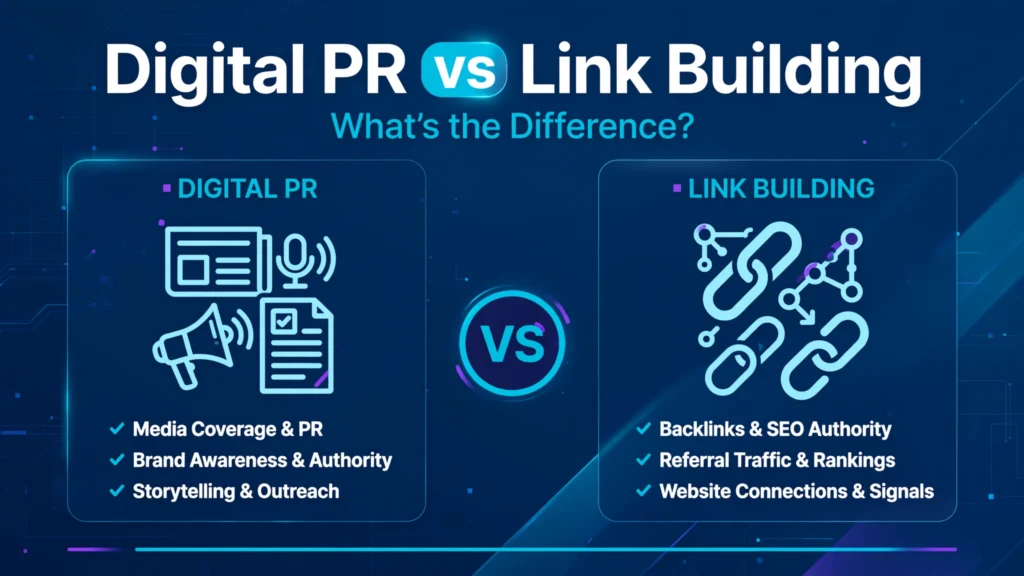
Ask ten SEOs to explain digital PR vs link building and you’ll get ten different answers — and half of them will just describe outreach twice with different buzzwords. The confusion costs real money: brands pay digital-PR retainers expecting backlinks, and buy backlink packages expecting press coverage. Both end up disappointed.
After running outreach campaigns for years, here’s the honest breakdown: digital PR and link building share one tool (outreach) but have different targets, different outputs, and different risk profiles. Understanding the difference is what lets you spend your budget on the one your site actually needs — or combine them properly.
What digital PR actually is
Digital PR is pitching stories to journalists, editors, and news desks. The target is coverage: an article about your brand, your data, your founder, or your opinion — published on a news site or high-authority publication. The link is a byproduct of the coverage, not the pitch itself.
Typical digital PR assets include:
- Original data studies and surveys (for example, an analysis of 500 outreach campaigns with reply-rate benchmarks)
- Expert commentary on trending news in your industry
- Founder stories, product launches, and company milestones
- Creative campaigns, rankings, and interactive content
The pitch goes to journalists who need stories, not webmasters who manage resource pages. Success is measured in pieces of coverage, referral traffic, brand mentions, and — yes — the editorial backlinks that usually come with real coverage.
What link building (outreach-driven) actually is
Link building is pitching placements to website owners, editors, and bloggers. The target is the link itself: a contextual backlink from a relevant page to yours. The tactics are familiar ones — guest posting services, link insertion services (niche edits), broken link building, and resource-page outreach.
The difference in mindset matters. A link builder asks: “Which pages on which sites could naturally reference my client’s content?” A digital PR asks: “What story would a journalist want to write about this brand?” Same inbox, completely different pitch.
If you’re weighing specific placement tactics, our comparison of niche edits vs guest posts breaks down cost, speed, and risk for the two most common ones.
Digital PR vs link building: the real differences
Strip away the jargon and the two approaches differ on five axes:
1. The target. Digital PR targets journalists at publications. Link building targets site owners, bloggers, and niche editors. Journalists need newsworthy stories; site owners need good content for their readers. Pitch the wrong asset to the wrong person and you get silence.
2. The asset. Digital PR needs something newsworthy — data, an opinion, a story. Link building needs something linkable — a definitive guide, a useful tool, original research a blogger would genuinely reference. Most company blogs have the second; very few have the first, which is why agencies usually have to create the PR asset before pitching it.
3. The link profile. Digital PR earns links from news domains and large publications — often high-authority, sometimes nofollowed (many news sites nofollow external links by policy), and usually with branded or generic anchor text you don’t control. Link building earns links from niche-relevant blogs with contextual anchor text you can influence. Both move rankings; they just build different-looking profiles.
4. Predictability and cost. Link building is a numbers game with fairly predictable math: a set number of pitches produces a predictable number of placements at a roughly stable cost per link. Digital PR is hit-or-miss by nature — one campaign can land twenty pieces of coverage or zero, and the upfront cost of the data study or creative asset is sunk either way. Retainers reflect that risk.
5. What else you get. This is the part link builders undersell. A digital PR campaign that lands real coverage also delivers brand searches, direct traffic, social proof (“as featured in…”), and sometimes actual customers. A link building campaign delivers rankings and organic traffic growth. Different scoreboards.
A note on risk (this matters)
One more difference, and it’s about staying on the right side of Google. Editorial links earned through genuine coverage or genuine outreach are what Google wants to reward. Links that exist because money changed hands for the link itself — paid placements dressed up as “PR” — fall under what Google’s spam policies describe as link spam. The line isn’t “PR good, link building bad” — it’s “earned versus bought.” Any agency selling you “digital PR links” that are really paid insertions on news-style sites is selling you risk, not PR.
Worth reading alongside that: Google’s own guidance on how links should work — crawlable, natural, and placed for readers, not algorithms.
Which one does your site actually need?
Honest answer: it depends on what you’re missing.
- Choose link building first if you’re a newer site with thin authority, you need rankings for commercial pages, you want a predictable cost per link, or your niche has strong independent blogs worth being featured on.
- Choose digital PR first if you already rank reasonably but your brand is invisible, you have (or can fund) genuinely interesting data or stories, you operate in a niche journalists actually cover, or you need the trust signals that come with press logos.
- Choose neither yet if your site has thin content that nobody would link to or write about. Fix the asset problem before spending on outreach — no pitch survives a weak page.
The smartest play: combine them
The best campaigns I’ve seen don’t pick a side — they sequence. Digital PR creates the linkable asset (the data study, the survey, the story); link building then pitches that same asset to every relevant blog and resource page in the niche. The PR campaign earns the hero links from publications; the outreach campaign multiplies them across the long tail of niche sites. One asset, two distribution engines, and a backlink profile that looks completely natural because it is.
This is also where dedicated link outreach services earn their keep: taking a great PR asset and making sure every relevant publisher in your vertical actually sees it, instead of hoping journalists do the distribution for you.
FAQs
Is digital PR just link building with a fancier name?
No. They share the outreach channel, but digital PR targets journalists with stories while link building targets site owners with linkable content. The skills overlap; the assets, targets, and success metrics don’t.
Which is better for SEO, digital PR or link building?
Neither is universally better. Digital PR tends to earn higher-authority editorial links with brand benefits attached; link building gives you more control over anchor text, relevance, and cost per link. Most strong backlink profiles have both.
Can digital PR links hurt my site?
Genuine editorial coverage won’t hurt you. What hurts is paid “PR placements” — links bought on news-style sites and labeled as digital PR. Those are link schemes, and Google treats them as such.
How much does digital PR cost compared to link building?
Digital PR usually costs more per campaign because you’re funding the asset (data, creative, research) plus the pitching, with no guaranteed link count. Link building is typically priced per placement, which makes the math more predictable.